Chain of Suspicion
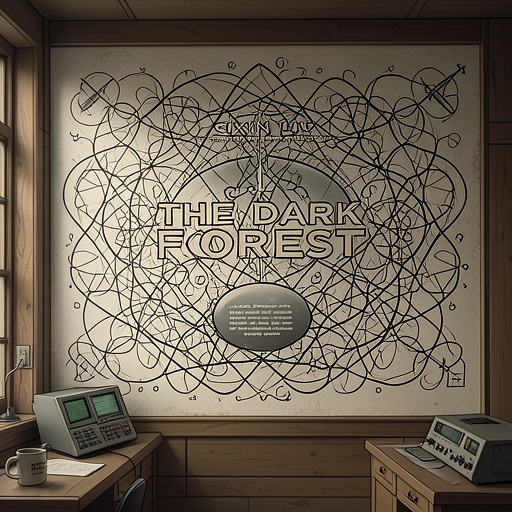
The Dark ForestThe Chain of Suspicion is the recursive uncertainty that arises when one civilization tries to judge another whose intentions, judgments, and future capabilities cannot be directly verified. Introduced alongside the two axioms of cosmic sociology, it explains why moral character alone cannot secure peace between distant civilizations: in a universe of delayed communication and uneven technological development, survival pressure turns uncertainty into a reason for preemptive action.
Definition and Logical Structure
Ye Wenjie identifies chains of suspicion as one of two concepts needed to derive a basic picture of cosmic sociology from its two foundational axioms, the other being the technological explosion. She tells Luo Ji that she has considered the axioms for most of her life but has never discussed them with anyone, then leaves him to work out the concepts’ implications. Her compressed explanation presents the Chain of Suspicion not as a single doubt but as an indefinitely recursive sequence of doubts about another civilization’s beliefs.
Luo Ji later reconstructs the logic in conversation with the distant world. A civilization may determine whether another society appears benevolent or malicious, but benevolence provides no assurance, because the other civilization cannot predict that the first is benevolent. Even if each side knows that the other regards it as benevolent, uncertainty immediately moves to the next level: neither side can be sure what the other thinks about what it thinks about the other’s intentions. The chain therefore grows through successive questions about knowledge, interpretation, and anticipated interpretation rather than through any direct evidence of hostility.
Why Cosmic Distance Makes the Chain Enduring
On Earth, the Chain of Suspicion is limited by conditions that make misunderstanding comparatively temporary. Humanity shares a species, cultural similarities, an interconnected ecosystem, and close physical distances. Communication can therefore resolve suspicion after one or two levels of inference. The social world is not free of mistrust, but its participants inhabit enough common ground for uncertainty to be repaired before it becomes irreversible.
Cosmic civilization lacks those stabilizing conditions. Communication across interstellar distances is so slow that clarification may arrive only after decisive events have already occurred. Biological differences between civilizations could reach the level of entirely different kingdoms, while cultural differences might be even more radical; vast distances would prevent ordinary contact from correcting the resulting interpretations. The chain can consequently become practically indestructible. By the time a message settles the question of intent, a defensive measure may already have been mistaken for an attack and answered with destruction.
The Battle of Darkness provides the clearest human-scale demonstration of this mechanism. The five ships of Starship Earth formed a quasi-cosmic civilization rather than a true one because all their inhabitants were human and remained relatively close in biological and cultural terms. Yet even this limited separation produced a Chain of Suspicion when the ships were placed under extreme uncertainty. The event thus becomes a warning that the logic does not require alien biology or absolute cultural incomprehension; distance and isolation alone can activate it.
Independence from Morality
The most important feature of the Chain of Suspicion is that it does not depend on whether the civilizations involved are internally benevolent or malicious. Luo Ji describes civilizations as points at the ends of chains: once they enter the network created by mutual uncertainty, their different moral qualities no longer determine the strategic result. A benevolent civilization may fear that another benevolent civilization cannot recognize its benevolence, while a malicious civilization may produce the same outwardly defensive calculations. The structure of the relationship makes them strategically identical.
This distinction separates the concept from a simple theory of evil. The danger does not arise because every civilization secretly desires conquest. It arises because each civilization must act while lacking reliable knowledge of the other’s intentions and future development. Suspicion becomes a property of the relationship itself, and the relationship can force morally different societies into equivalent patterns of concealment, preparation, and attack.
Technological Explosion and the Security Dilemma
The Chain of Suspicion becomes especially dangerous when joined to the technological explosion. Shi Qiang tests Luo Ji’s argument with a practical objection: if a stronger civilization discovers a weaker one, the stronger society may eventually be found in turn; if the weaker civilization is allowed to survive, it may undergo a technological explosion and become stronger at any moment. In either case, the continued existence and continued awareness of the other become potential threats.
This logic explains why merely announcing one’s existence is hazardous. A civilization cannot know whether its present superiority will last, whether the other side is concealing capabilities, or whether a future breakthrough will radically alter the balance. Waiting for certainty is therefore not neutral. It gives the suspected rival time to develop, while action taken too early may destroy a society that was not actually hostile. The Chain of Suspicion converts the absence of trustworthy knowledge into a permanent security dilemma.
Narrative and Historical Consequences
The concept also clarifies the wider crisis between Earth and Trisolaris. The sophons make Earth transparent to the Trisolarans, exposing meetings, records, computer data, military plans, and technological programs. Yet total visibility does not create mutual understanding. The Trisolarans can read human language and information but cannot read human thoughts, while human civilization cannot reliably infer how Trisolaris interprets what it observes. Transparency therefore removes secrecy without removing uncertainty about intention; indeed, it makes the preservation of hidden thought politically decisive.
The Wallfacer Project is founded on this asymmetry. Since the sophons cannot read human thoughts, Wallfacers can construct strategies entirely within their minds while presenting false motives and misleading actions to the outside world. The project turns the Chain of Suspicion into an organized defense: humanity deliberately makes its own intentions unreadable because open communication would expose every plan to the enemy. The resulting deception is not an accidental moral failure but a strategic response to a universe in which knowledge cannot be separated from vulnerability.
The same logic reverberates through the Solar Fleet. Technological choices, command structures, and military loyalties become dangerous because each side must judge what the other may do before communication can settle the matter. Even the second assassination order against Luo Ji, issued by Trisolaris and conveyed through the sophons, demonstrates how an enemy can act on a judgment that remains opaque to the target. The order is significant precisely because Luo Ji cannot know why he has become important enough to kill, while Trisolaris can treat his unknown potential as sufficient grounds for elimination.
The annihilation of the combined fleet and the later Battle of Darkness give the Chain of Suspicion a civilizational consequence. After the fleet’s destruction, Escapism revives, but the conduct of surviving warships turns escape into a moral and political horror: once the spiritual bonds with Earth are severed, spacefaring survivors appear capable of becoming a separate and hostile form of civilization, named Negacivilization. The episode extends the concept beyond interstellar species. Even humans who share one origin can become mutually alien when separation, fear, and uncertain intentions destroy the conditions that make trust repairable.